
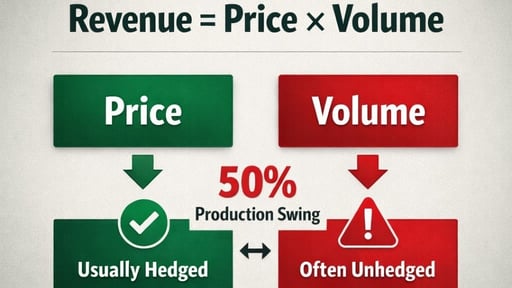
Most agribusinesses manage price risk well. Forward contracts, pools and derivatives are standard practice across grain, cotton and other commodities.
But revenue has two components: Revenue = Price x Volume
While price is often hedged, volume risk is usually not. In one of the most climatically volatile production environments in the world, that matters.
ENSO cycles, Indian Ocean Dipole shifts and increasingly clustered drought and flood events mean yield variability is structural - not occasional. In some regions, the variance between strong and weak seasons has widened significantly over the past decade.
When regional production falls materially below trend, the impact flows through the entire value chain:
• Broadacre farms exposed to rainfall variability
• Permanent crop industries with long-lived capital and infrastructure
• Grain handlers, cotton gins and processors facing throughput swings
• Exporters managing shipping programs dependent on reliable supply
In drought years, grain receivals in some regions can fall 30–50 percent below average, leaving infrastructure underutilised while fixed costs remain.
Traditional tools only partially address this exposure:
• Price hedging protects commodity prices but not production shortfall
• Crop insurance is typically farm-level and focused on damage, not enterprise earnings
• Geographic diversification reduces local risk but not correlated regional shocks
The result is a structural reality: when regional output declines, enterprise earnings absorb the shock.
As production volatility widens, some parts of the industry are beginning to explore new approaches.
One example is regional, index-linked frameworks tied to independently published production statistics (such as ABS or ABARES data). These structures aim to stabilise revenue when regional output deviates materially from long-term norms.
They are not a replacement for insurance or pricing strategies.
They simply address the volume side of the revenue equation that often sits unhedged.
Ceres AI and Munich Re are currently exploring how regional production data, climate analytics and financial structuring can help agribusinesses better understand this exposure.
As Australian agriculture continues to industrialise and attract institutional capital, balance sheet resilience may become just as important as agronomic performance.
Production volatility is not just a seasonal inconvenience: It is an enterprise risk.
Meet the Author
 Ian Lowles - GM USA, Australia & JPAC
Ian is a senior General Manager and sales-led executive with more than 20 years’ experience building, scaling and leading enterprise software and services businesses across ANZ, APAC, JPAC and the United States.